Most of Your Sim's Traits Do Nothing
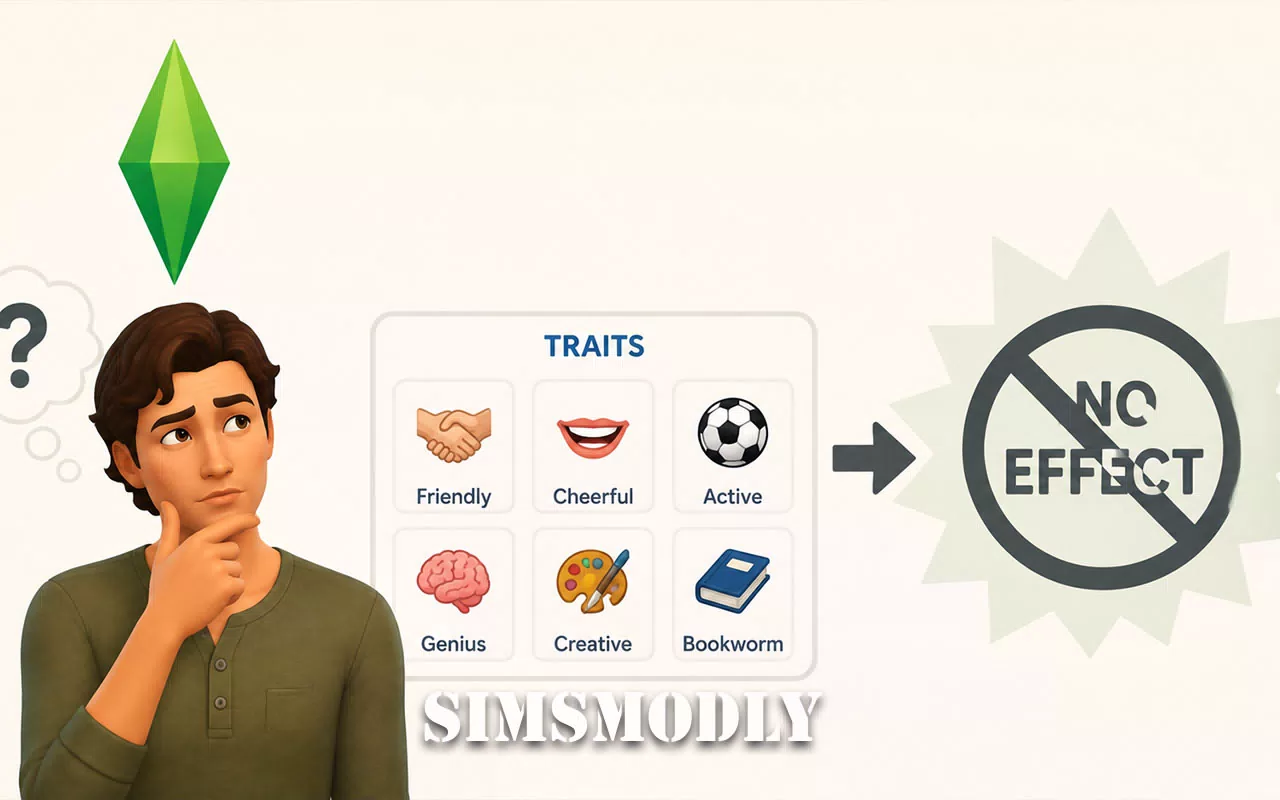
You spend fifteen minutes in Create-A-Sim agonizing over the perfect three traits. Maybe you go for Ambitious, Perfectionist, and Genius because you're building a tech mogul. Feels intentional. Feels like it's going to shape everything your Sim does.
Then you actually play them, and... mostly nothing happens. They occasionally get a moodlet. That's kind of it.
Turns out that's not you missing something — it's the game. A big chunk of Sims 4's trait list was never built to change how your Sim behaves. It was built to give you something to type into a bio. There's a real, meaningful split between traits that touch gameplay systems and traits that are pure flavor text with a moodlet attached, and once you know which is which, picking traits stops being a guessing game.
The Trait Tiers Nobody Tells You About
A community-built breakdown that made the rounds a while back sorted every trait in the game into buckets, and the categories say a lot on their own: traits that meaningfully affect gameplay, traits good for storytelling, traits that mostly just hand out positive or negative moodlets, and — this is the telling one — a bucket for traits that seemingly have little effect on gameplay at all. The gameplay-impact bucket was, by a wide margin, the smallest of the four. The storytelling category, on the other hand, ended up as the single biggest group, packed with close to twenty different traits.
That's the split in a nutshell. Some traits rewire how your Sim interacts with the world. Most just color in the personality description and leave the actual behavior untouched.
Traits That Are Genuinely Doing Work
Here's what separates a "real" trait from a flavor one: it either unlocks interactions nothing else can, blocks something outright, or meaningfully shifts how a career or system evaluates your Sim.
Kleptomaniac is the poster child for this. It doesn't just make your Sim feel sticky-fingered — it unlocks an entire stealing interaction set that other Sims simply don't have access to, turning shoplifting into a real, repeatable gameplay loop rather than a joke in a bio.
Hot-Headed does something similar in a smaller way. Beyond the random Angry moodlets, this trait is specifically useful for climbing the Criminal Career's Boss branch, since that path requires racking up enemies, and a Sim who's mechanically primed to rile people up gets there faster than one who isn't.
Freegan, from Eco Lifestyle, works the same way as Kleptomaniac — it's not just a description, it opens dumpster-diving and resourceful behaviors that are otherwise locked away from Sims who don't have it.
Compare all of that to Dance Machine, a trait that sounds like it should matter — who wouldn't want a Sim built around dancing? — but according to one of the most detailed trait breakdowns out there, its actual mechanical footprint is a boost at nightlife venues and slightly better naps. Beyond that, it doesn't have a major impact on gameplay as far as anyone's been able to document. It's a real trait, it does something, but it's nowhere near the systemic depth its name implies.
The Moodlet-Only Middle Ground
Most traits actually land somewhere between "fully mechanical" and "fully cosmetic": they don't unlock new interactions, but they do genuinely tilt your Sim's emotional weather. A creative Sim really can randomly become Inspired out of nowhere. A Sim who loves the outdoors really will slide into a bad mood if you trap them inside for days. This isn't nothing — emotions in Sims 4 affect autonomous choices and even how well a Sim performs at certain activities — but it's an indirect effect layered on top of the emotion system, not a trait doing its own unique thing.
This is genuinely where the bulk of the trait list lives. It's why traits feel like they're doing more than they are — the moodlets are visible and frequent, so it reads as personality, even when the trait's entire job is "occasionally hand out a mood."
Kids Traits Play a Slightly Different Game
Worth calling out separately: traits for child Sims interact with a confidence system that adult traits don't touch at all. A child's confidence can rise or fall based on skill gains, school performance, and how caregivers react to their behavior — praise versus criticism actually matters mechanically here, not just narratively. Teens have their own version of this loop tied to how they behave in high school, where social interactions and diligence with schoolwork feed into the traits and bonuses they earn as they age up. It's one of the few places where trait-adjacent systems are doing more, not less, than most adult traits manage.
So How Do You Actually Pick Good Traits?
If you're building a Sim purely for the story you want to tell, the "does nothing mechanically" traits are completely fine — that's what they're for. But if you want your CAS choices to actually show up in gameplay, here's the real filter to run each trait through:
Does it unlock an interaction other Sims don't have? That's a real gameplay trait.
Does it meaningfully help or block a specific career or aspiration path? Also real.
Does it only add a moodlet you'll see in the top-left corner sometimes? That's flavor with light seasoning.
Does the trait's own description promise something specific and dramatic, and independent write-ups can't point to a mechanic beyond mood swings? That's the "sounds cool, does little" category — not bad, just don't expect it to run your Sim's life.
None of this means the flavor traits are a waste of a slot. If you're roleplaying, the personality description is the whole point. But if you've ever wondered why your carefully-built genius mogul Sim doesn't feel meaningfully different from a normal Sim day to day, this is usually why — you loaded up on traits that were built to be read, not played.
Frequently Asked Questions
Are storytelling traits a waste of a trait slot?
Not if storytelling is what you're going for — they're doing exactly what they're designed to do. They're only a "waste" relative to a goal they were never built to serve, which is deep mechanical impact.
How many traits can a Sim actually have?
Adult Sims get three trait slots by default in Create-A-Sim, though Growing Together's Self-Discovery system lets young adults, adults, and elders unlock three additional traits over time, for a possible total of six.
Do townie (NPC) Sims get the same traits as player-made Sims?
Yes — townies generate with their traits already assigned rather than through Create-A-Sim, but they draw from the exact same trait pool and follow the same mechanical rules as a Sim you built yourself.
Is there an official in-game way to see which traits are "gameplay" versus "flavor"?
No, the game doesn't label them that way anywhere in the UI — this distinction only exists because of community documentation and testing, not an official tier system from the developers.
Trait mechanics referenced here reflect community documentation and testing rather than official developer breakdowns, since the game itself doesn't publish a mechanical-versus-cosmetic distinction.