The Invisible Bar That Decides Who Your Sim Grows Up To Be
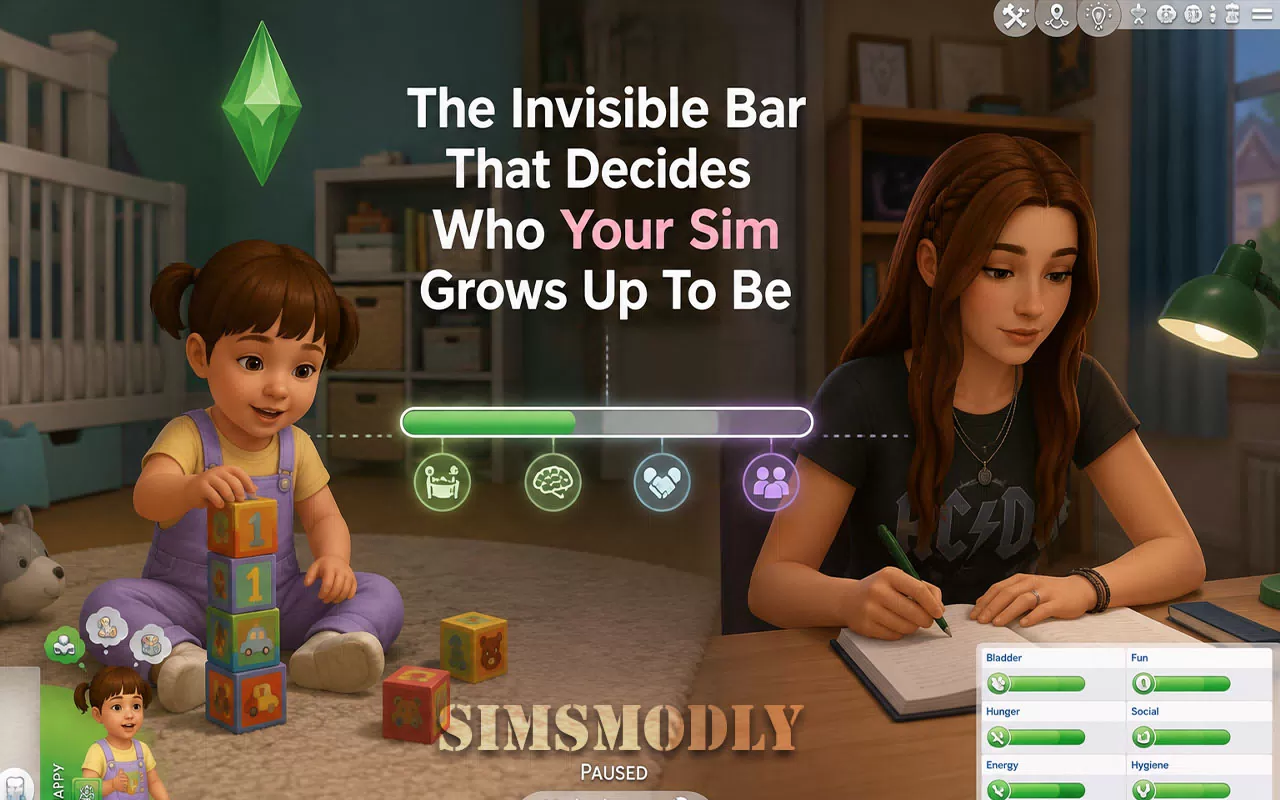
Every time you praise a toddler for cleaning up their toys, or let a teenager get away with talking back for the tenth time, something is being tracked that never shows up as a moodlet and barely gets mentioned in-game. It's not a want, not an aspiration, and not a trait — not yet. It's a slow-moving score sitting quietly in the Simology panel, and by the time your Sim ages into a Young Adult, it will have already decided a permanent piece of who they are.
That's Character Values, added in the Parenthood Game Pack, and it's one of the only systems in The Sims 4 where childhood choices you barely register as significant lock in a real, lasting personality trait years later — with no undo button once the age-up happens.
Five Values, Tracked From Toddler to Teen
Character Values only exist for Sims between toddler and teen — the panel disappears once a Sim becomes a Young Adult, because by then its job is already done. There are five separate values tracked simultaneously: Manners, Responsibility, Empathy, Conflict Resolution, and Emotional Control. Each one moves independently based on specific interactions a child performs or has performed on them, and each can swing in either a positive or negative direction depending on how the Sim is actually raised.
Manners reflects behavior at home — how a Sim conducts themselves during meals, chores, and everyday household interactions.
Responsibility rises with things like finishing homework and helping with tasks, and is generally the easiest of the five to build up quickly.
Empathy tracks how a Sim treats others — being mean, mocking, or trolling drags it down, while playing kindly with other Sims and volunteering time pushes it up.
Conflict Resolution measures how well a Sim handles disagreement, built through resolving disputes, repairing damaged relationships, and apologizing.
Emotional Control reflects how well a Sim manages strong feelings — negative emotions like anger and jealousy push it down, while calming activities like jogging, journaling, or playing an instrument help pull it back up.
None of these values are visible anywhere except the Simology panel for a Sim in that toddler-to-teen age range, which is exactly why so many players raise several generations of kids without ever noticing the system tracking them.
Why This Isn't Just Flavor Tracking
Here's what separates Character Values from a background statistic: max out or bottom out one of these five values by the time a Sim reaches Young Adult, and the game locks in a corresponding permanent trait — something like Compassionate on the positive end of Empathy, or Bad Manners on the negative end of that value. This isn't a temporary moodlet or a phase; it's the same kind of permanent trait slot that Create-A-Sim traits occupy, generated entirely from how the Sim was actually raised rather than picked by the player.
That makes Character Values one of the only mechanical bridges in the entire game between how a child is parented and who that Sim becomes as an adult — the disciplinary or nurturing choices you make during the toddler-through-teen window aren't just roleplay flavor, they're quietly writing a permanent trait file that activates the moment the Sim ages up.
The Multiplier Nobody Reads The Fine Print On
There's a reward trait, Role Model, earned by completing the Super Parent aspiration, that gives a bonus to Character Value scoring whenever the Sim carrying it is near toddlers, children, or teens. In practice, this means a household with a Role Model parent actively raises Character Values faster across the board simply through proximity — a detail that matters a lot for anyone deliberately trying to steer a child toward a specific trait outcome rather than leaving it to chance.
Parenting also isn't purely mechanical about interaction type — a parent's own mood affects how well parenting attempts land. Disciplining or praising a child while angry or sad is measurably less effective than doing the same thing while in a good mood, which means the timing of a parenting interaction matters almost as much as the interaction itself.
Playing It Deliberately
Decide the target trait before the Sim ages out of Teen. Character Values only track up to Teen, so any deliberate shaping needs to happen well before the household stops seeing the panel at all.
Use consistent parenting interactions, not occasional ones. A single praised chore barely moves the needle — these values shift gradually and reward a sustained pattern over many interactions.
Watch the parent's mood before parenting. A calm or happy parent gets more out of the same praise or discipline interaction than an angry or sad one attempting the identical action.
Consider Role Model for legacy or multi-generation saves. If you're deliberately raising several kids toward specific outcomes across generations, the proximity bonus compounds noticeably over a large household.
Frequently Asked Questions
What age range actually has Character Values?
Only toddlers, children, and teens have Character Values tracked in their Simology panel — the system stops applying once a Sim becomes a Young Adult.
Do Character Values affect a Sim permanently?
Yes, indirectly. Maxing or bottoming out a value by Young Adult locks in a corresponding permanent trait, like Compassionate or Bad Manners, that stays with the Sim for the rest of their life.
Can I raise Character Values quickly with cheats?
Yes. Character Value cheats exist and can raise or lower any of the five values directly, useful for challenges or for quickly setting up a specific trait outcome without playing out the full childhood.
Does a parent's mood affect how well parenting interactions work?
Yes. Parenting interactions performed while a parent is angry or sad are less effective at shifting Character Values than the same interactions performed while the parent is in a good mood.
Sources
GameRant — The Sims 4: Parenthood - Character Values, Explained
Ultimate Sims Guides — The Sims 4: Character Values (Parenthood)
Carl's Sims 4 Guide — The Sims 4 Parenthood: Character Values Guide
Mechanic details reflect the Parenthood Game Pack as documented by community guides since its 2017 release; specific interaction lists have been expanded slightly by later packs adding new parenting-adjacent content.