Why Your Sims Ignore You (It's Actually Math)
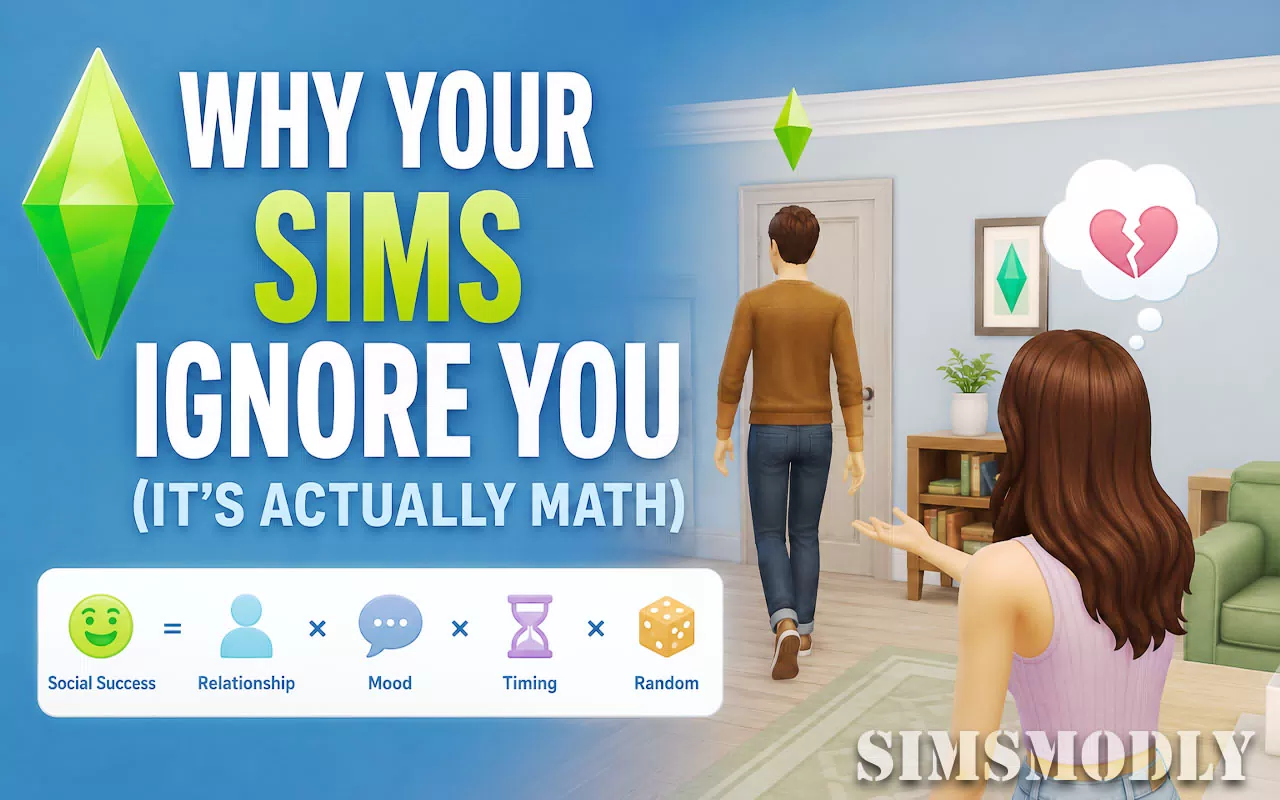
You queue up a nice relaxing bubble bath. Your Sim strolls right past the tub, sits down, and starts eating a cold hot dog off the counter instead. You didn't ask for that. Nobody asked for that. And yet here we are, again, watching free will ruin a perfectly good screenshot.
Here's the thing though — your Sim isn't malfunctioning. There's an actual formula running under the hood every time a Sim makes a "random" choice, and once you know how it works, their chaos starts looking a lot less random and a lot more like a spreadsheet with feelings.
Every Object Is Yelling at Your Sim
The core idea is something called signal strength. Every interactive object on the lot is constantly broadcasting a kind of invisible "pick me" signal to nearby Sims, and when a Sim's autonomy kicks in, the game is essentially running an auction between every signal in range and handing control to whichever one shouts loudest.
A few things crank that volume up or down:
Need level. If a Sim's hunger is in the gutter, the fridge's signal gets boosted hard. A well-fed Sim barely hears it.
Personality traits. A serious Sim is more likely to autonomously pick the chess table or a book over the TV, while an active Sim leans toward physical activities — the object doesn't change, but how loudly it "calls" to that specific Sim does.
Distance. All else being equal, the closer object usually wins, because the game favors convenience over an ideal choice three rooms away.
So that bubble bath you queued wasn't ignored out of spite. The hot dog's signal, boosted by a hunger need you probably weren't watching, was simply screaming louder in that exact moment.
The Actual Pecking Order
When multiple needs are all screaming at once, the game doesn't just pick randomly — there's a rough hierarchy it leans on. The commonly cited priority order runs Hunger, then Energy, then Hygiene, then Bladder, then Comfort, then Social, then Fun, with environment factored in more randomly on top of that stack.
This is why a low-comfort, low-fun Sim will still beeline for a snack before flopping onto a couch, and why "just let them be autonomous for a bit" so often turns into ten minutes of watching a Sim aggressively solve their most urgent physical need while every one of your carefully planned activities gets shoved to the back of the line.
Free Will Has a Volume Knob, Not Just an On/Off Switch
Most players know you can toggle Autonomy in the options menu, but it's genuinely a dial, not a binary switch. With it fully on, a Sim will handle basically everything themselves — heading to work, doing chores, managing their own needs — sometimes to a fault, since that same independence is what lets them wander off and, say, get themselves killed doing something reckless while you're not looking. Turning it off doesn't remove decision-making entirely, either: a Sim with autonomy disabled will still act to preserve their own life, like climbing out of a pool before drowning, because survival-level behavior sits outside the normal free-will system.
There's also a middle ground a lot of players miss: you can disable autonomy for one specific Sim while leaving everyone else on full free will, which is the actual fix for the classic problem of "I only want to control my main Sim, but I don't want to babysit the other seven people in this house."
Emotions Are Quietly Steering Too
On top of needs and traits, a Sim's current emotional state nudges their autonomous choices and even how they perform an action, not just which action they pick. A playful Sim might randomly burst into laughter mid-task. A sad Sim might cry through an interaction that has nothing to do with why they're sad. None of this is scripted per-situation — it's the emotion system layering a "how" on top of whatever the signal-strength system already decided was the "what."
Why the Modding Community Cares So Much About This
If you spend any time in Sims 4 mod communities, you'll notice a huge chunk of the most popular gameplay mods exist purely to mess with this exact system — because the base game's autonomy has one big blind spot: it's built around needs and signal strength, not around a Sim's actual stated Wants. Community-built systems have stepped in specifically to fix that, letting Sims autonomously chase their own Wants based on a hidden, decaying satisfaction meter, with a tiered priority system of their own layered on top: reactionary Wants get first pick while they're relevant, short-term Wants sit in the middle, and long-term Wants wait quietly for the right opportunity, while anything you've personally pinned stays completely off-limits to the automated system. It's essentially a fan-made patch to the priority list, running the same auction logic the base game uses, just with a category the base game barely considers.
The Takeaway
Your Sims aren't ignoring your plans out of spite — they're running a constant, invisible auction between every need, object, and emotional state in range, and the loudest bidder wins every single time. Once you know hunger will basically always outshout comfort, and that a serious Sim will always eye that chess set over the TV, "random" free will decisions start looking a lot more like reading a Sim's mind in real time.
Frequently Asked Questions
Does turning off autonomy make Sims completely helpless?
No. Even with Autonomy fully off, Sims will still take self-preserving actions, such as getting out of a pool before drowning, since basic survival behavior isn't governed by the same free-will toggle as everyday choices.
Why does my Sim keep canceling actions I queue up?
This usually happens when a need crosses a threshold urgent enough to override your queued command — the signal-strength system treats a critical need as loud enough to interrupt whatever you'd planned, especially for needs high on the priority order like Hunger or Bladder.
Can I control autonomy for just one Sim in a household?
Yes — there's a specific option to disable autonomy for a single selected Sim while every other household member keeps their normal free will, which is the standard fix for wanting full control over one Sim without micromanaging an entire house.
Do traits actually change what a Sim will choose, or is it random?
Traits act as a modifier on top of an object's base signal strength rather than the deciding factor — the object's pull still matters most, but a matching trait can be enough to tip a close decision in one direction.
Sources
Priority orders and signal-strength behavior described here reflect commonly documented base-game logic; individual results can vary with installed mods, traits, and expansion-specific systems.